Trigonometry Homework Help: A Free AI Tutor for Sin, Cos, and Tan
By ADMIN | Updated on: November 2026
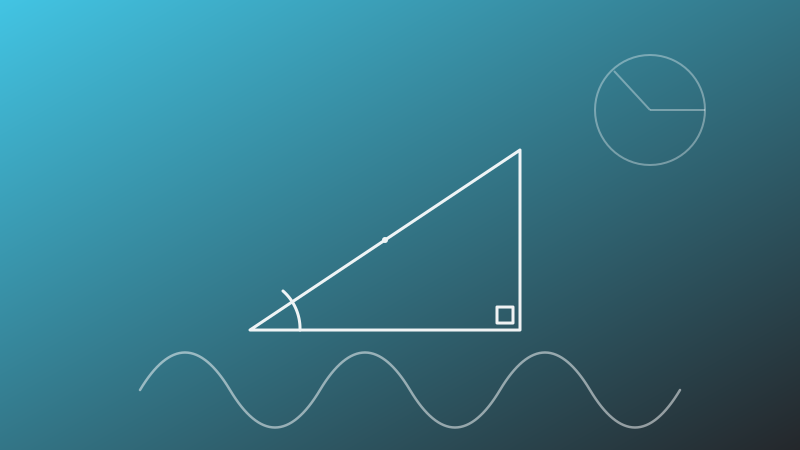
Trigonometry homework usually starts the same way: a right triangle, an angle, and three letters you half-remember — SOH, CAH, TOA. This guide breaks down sine, cosine, and tangent in plain language, walks through the problems that trip students up most, and shows you how to use an AI tutor to check your work instead of just copying an answer.
You can also paste any trig problem into our free AI trigonometry solver for an instant, step-by-step walkthrough while you read.
What Is Trigonometry, Really?
Trigonometry is the branch of math that connects the angles of a triangle to the lengths of its sides. That's really it. Once you know one angle and one side of a right triangle, trig lets you figure out everything else.
It builds directly on geometry and algebra. If you can solve for x in an equation and you understand how a right triangle is put together, you already have what you need to start.
The Big Three Ratios: Sine, Cosine, and Tangent
Every trig problem starts from three ratios, each comparing two sides of a right triangle relative to one of its angles (call it angle A):
- Sine (sin A) = opposite side ÷ hypotenuse
- Cosine (cos A) = adjacent side ÷ hypotenuse
- Tangent (tan A) = opposite side ÷ adjacent side
The hypotenuse is always the longest side, opposite the right angle. "Opposite" and "adjacent" depend on which angle you're looking at, which is the part students mix up most.
SOHCAHTOA: The Easiest Way to Remember Them
SOHCAHTOA is just the first letters of the three ratios above, grouped together: Sin = Opposite/Hypotenuse, Cos = Adjacent/Hypotenuse, Tan = Opposite/Adjacent. Say it out loud a few times before a test — it's faster than re-deriving the ratios from scratch.
Example: a ladder leans against a wall at a 60° angle and reaches 10 feet up the wall. How long is the ladder? The 10-foot wall height is the side opposite the 60° angle, and the ladder itself is the hypotenuse, so sin(60°) = 10 ÷ ladder length. Solving gives a ladder length of about 11.5 feet.
Trigonometry isn't a hundred separate rules to memorize — it's one relationship between angles and sides, reused in a dozen different disguises.
Degrees vs. Radians (And Why Both Exist)
Angles can be measured in degrees (a full circle = 360°) or radians (a full circle = 2π). Degrees are more intuitive for everyday use; radians show up constantly once you reach calculus, because they make certain formulas much simpler.
The one habit that saves the most homework points: always check which mode your calculator is in before you start a problem. A correct setup with the wrong mode still gives a wrong answer.
The Unit Circle, Explained Simply
The unit circle is a circle with a radius of exactly 1, centered at the origin of a graph. Every point on it corresponds to an angle, and the coordinates of that point are literally (cos, sin) of the angle.
You don't need to memorize the whole circle at once. Start with the "special angles" — 0°, 30°, 45°, 60°, and 90° — since those are the values teachers test most often, and the pattern repeats in every quadrant.
Common Trigonometry Homework Problems (And How to Solve Them)
Right-Triangle Word Problems
These describe a real situation — a kite string, a ramp, a shadow — and ask you to find a missing side or angle. Draw the triangle first. Label the right angle, the given angle, and whatever side you already know. Then pick the ratio (sin, cos, or tan) that connects the side you know to the side you want.
Law of Sines and Law of Cosines (Non-Right Triangles)
SOHCAHTOA only works on right triangles. For any other triangle, you need one of two tools. The Law of Sines works when you know an angle and the side directly across from it, plus one more angle or side. The Law of Cosines works when you know two sides and the angle between them, or all three sides and need an angle.
A quick way to choose: if you have an angle and its opposite side as a matching pair, use the Law of Sines. If you don't have a matching pair, use the Law of Cosines.
Worked example: a triangle has angle A = 40°, angle B = 60°, and the side opposite angle A is 8 cm. Find the side opposite angle B. Since you have a matching angle-side pair, use the Law of Sines: 8 ÷ sin(40°) = side-b ÷ sin(60°). Solving for side-b gives roughly 10.8 cm.
Trig Identities You'll Actually Use
Identities are equations that are always true, no matter the angle. The one you'll see most is the Pythagorean identity: sin²(A) + cos²(A) = 1. Teachers use identities to test whether you understand the relationships, not just the ratios — practicing a handful of identity-simplification problems covers most of what shows up on a quiz.
What Do Sine and Cosine Graphs Look Like?
Once you plot sin(x) or cos(x) on a graph instead of a triangle, they turn into smooth, repeating waves — this is where trig connects to sound, light, and electricity, which all move in wave patterns. Two features describe any trig graph: the amplitude (how tall the wave is, measured from the midline to the peak) and the period (how long it takes the wave to repeat one full cycle).
The sine and cosine graphs look identical in shape — they're the same wave, just shifted sideways from each other. If a homework problem asks you to compare the two, that shift, rather than the shape, is usually what it's testing.
Why Trigonometry Feels Harder Than Algebra
It's not that trig is more advanced than algebra — it's that it asks you to switch between a picture (the triangle or graph), a ratio (the fraction), and an equation (the formula) all at once. That's a different kind of thinking than solving for x in a line of symbols, and it takes most students a few weeks to adjust to.
The fix isn't more memorization. It's drawing the triangle (or sketching the graph) every single time, even for problems that seem simple, until matching a picture to a ratio becomes automatic. Students who skip the drawing step tend to mix up "opposite" and "adjacent" the most, since those labels change depending on which angle you're using.
How an AI Homework Helper Can Help You Learn Trig
Paste a problem into our free trigonometry solver and you'll get a full, step-by-step walkthrough — not just a final number. Read each step and ask yourself why it comes next before moving to the one after it.
The most useful habit: solve the problem yourself first, then check your steps against the AI's. If you only match on the final answer, you'll find out you misunderstood a step on the next test instead of today. Our AI math solver works the same way for algebra and calculus questions that lead into trig.
If your class is working through identities or the unit circle, Premium's Practice Sets and Flashcards features let you drill the special angles and identities repeatedly until they stop needing a lookup.
What Grade Do You Learn Trigonometry?
This varies by school, state, and course sequence, so treat it as a general pattern, not a rule. In most US schools, trigonometry topics appear during Algebra 2 or a dedicated Precalculus course, commonly in 10th or 11th grade. Some schools teach trig as its own one-semester class; others spread it across geometry and precalculus instead.
5 Tips to Get Better at Trigonometry, Fast
- Draw the triangle every time. Even "easy" problems get easier to see once they're on paper instead of in your head.
- Learn SOHCAHTOA before anything else. It's the single tool you'll reach for most often.
- Memorize the five special angles (0°, 30°, 45°, 60°, 90°) on the unit circle before trying to memorize the whole thing.
- Check your calculator's angle mode before every homework session — degrees vs. radians is the single most common silent mistake.
- Practice identity problems in small batches — five problems a day beats twenty the night before a test.
Frequently Asked Questions
What is trigonometry actually used for?
Trigonometry connects angles to distances, which is why it shows up in construction, navigation, physics, video game graphics, and astronomy. In school, it's also the bridge to precalculus and calculus.
What is the easiest way to remember sine, cosine, and tangent?
SOHCAHTOA: Sine = Opposite/Hypotenuse, Cosine = Adjacent/Hypotenuse, Tangent = Opposite/Adjacent. Saying it out loud a few times helps it stick faster than memorizing three separate formulas.
Is trigonometry harder than algebra?
Trigonometry builds on algebra rather than replacing it, so it can feel harder at first because you're applying algebra skills in a new, more visual context. It usually clicks once the unit circle and the three basic ratios make sense.
What math do I need to know before starting trigonometry?
You should be comfortable with basic algebra and the geometry of triangles, including the Pythagorean theorem. Most US students take trigonometry during or shortly after Algebra 2.
What grade do students usually learn trigonometry?
This varies by school and state, but it most commonly appears in Algebra 2 or Precalculus, usually around 10th to 11th grade.
Can AI actually help me understand trigonometry, not just give me answers?
A good AI homework helper shows its steps, so you can see which ratio or identity was used and why. Use it to check your own work, then try a similar problem without looking.
What is the difference between the Law of Sines and the Law of Cosines?
Both solve triangles without a right angle. Use the Law of Sines when you have an angle and its opposite side as a matching pair. Use the Law of Cosines when you have two sides and the angle between them, or all three sides.
Do I need a calculator for trigonometry homework?
For problems with decimal angle values, yes — set it to the correct mode first (degrees or radians). For exact-value problems like 30°, 45°, and 60°, you're usually expected to know the values without one.
What's the difference between a sine graph and a cosine graph?
They're the same wave shape, just shifted sideways from each other. If a homework problem asks you to compare the two graphs, that shift — not the shape — is usually what it's testing.
Keep Practicing
Trigonometry rewards repetition more than raw talent. Work through a few problems a day, draw every triangle, and lean on a free AI trigonometry tutor to check your reasoning, not just your final answer.
For more on the subjects that come right before and after trig, see our guides to geometry lessons and algebra homework help. If you want to go deeper on the unit circle at your own pace, Khan Academy's free trigonometry course and OpenStax's Precalculus textbook are both solid, free references.